
The Hormuz Strait Crisis and Our Fossil Fuel Dependence: A System Problem the World Can No Longer Ignore
By Robert Steele | May 15, 2026
In the past couple of months, the world has been reminded how fragile the modern global economy really is.
Following the Israeli and United States military strikes on Iran, including attacks on Iranian military infrastructure and escalating direct confrontation between the three countries, the Strait of Hormuz rapidly became one of the most dangerous geopolitical flashpoints on Earth. Iran responded with missile and drone attacks, threats against commercial shipping, and partial restrictions on maritime transit through the strait - the critical energy chokepoint through which roughly one-fifth of globally traded oil and major LNG supplies normally pass. Shipping traffic sharply declined as insurers raised risk premiums, naval forces mobilized, and commercial vessels hesitated or rerouted amid fears of attack, seizure, or blockade. Oil markets reacted immediately. Governments began contingency planning.
And suddenly, the world was forced to confront a deeply uncomfortable reality; the stability of the global economy remains heavily dependent on the uninterrupted flow of fossil fuels through one of the world’s most militarized and geopolitically volatile regions.
That should disturb us more than it appears to, based on my online and personal observations.
What the Strait of Hormuz crisis really exposes is not merely geopolitical instability, but systemic dependency. The modern world remains deeply locked into a fossil fuel economy whose vulnerabilities cascade through energy systems, food systems, financial markets, supply chains, geopolitics, and ultimately the stability of the Earth system itself.
For all the talk of sustainability transitions, green growth, renewable energy revolutions, and net-zero ambitions, the global economy still behaves like a civilization tethered to oil.
A disruption in one narrow stretch of water now sends shockwaves through financial markets, food systems, transportation networks, global supply chains, and household economies across the planet.
That is not resilience. It is systemic dependency.
And it reveals why fossil fuel dependence is not simply an environmental problem or a climate problem. It is a “wicked systems problem”, one woven throughout the architecture of globalization itself.
Last year, I participated in a systems thinking workshop in Bangkok facilitated by David Peter Stroh. His work helped sharpen something I had long sensed in sustainability and social change work: many of the world’s most persistent crises continue not because humanity lacks solutions or good intentions, but because we tend to focus on symptoms, short-term events, and recurring patterns of behaviour, while failing to address the deeper structures and mental models that continuously reproduce the problems themselves.
The current fossil fuel crisis surrounding the Strait of Hormuz feels exactly like the kind of systems problem David Peter Stroh describes in his work.
Societies often become trapped reacting to crises, disruptions, and visible events without confronting the deeper structures, assumptions, and dependencies that continuously reproduce those crises in the first place.
In this sense, the restrictions and instability surrounding the Strait of Hormuz are not the root problem. They are symptoms of a much larger systemic condition: a global civilization still deeply dependent on a fossil fuel economy that remains economically volatile, geopolitically fragile, and ecologically unsustainable.
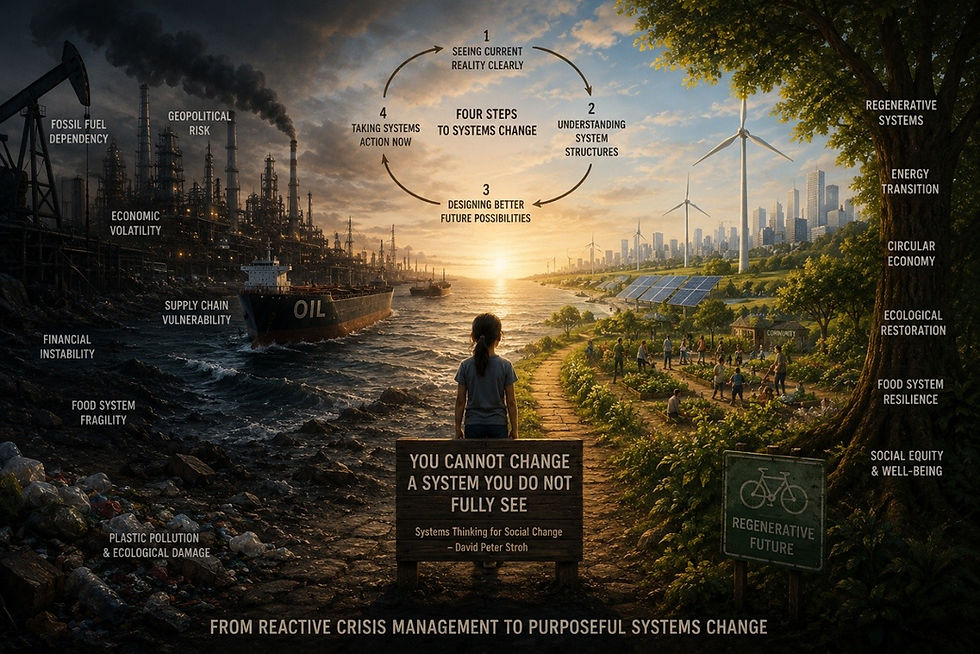
Stroh’s four-step approach to social change offers a useful lens for understanding not only why this dependency persists, but also why meaningful transformation has proven so difficult, and where genuine leverage for change may actually lie.
Step One: Seeing Current Reality Clearly
One of the central lessons of systems thinking is that lasting change becomes almost impossible when we focus only on visible events while remaining blind to the deeper system shaping them.
The problem is that fossil fuel dependence has become so deeply embedded in modern society that, during periods of stability, it is almost invisible to us. Most people do not experience oil as a vast interconnected system shaping economies, politics, infrastructure, food, and daily life. It is simply experienced as “normal.”
It powers transportation networks, shipping, industrial agriculture, aviation, plastics, manufacturing, military logistics, electricity generation, construction, and global tradeใ
Entire cities have been designed around assumptions of infinite cheap energy abundance.
Entire economies have been structured around uninterrupted material throughput.
Then a disruption like this occurs.
Suddenly, people now realize that food prices are linked to oil and fossil fuels. Fertilizer is linked to natural gas. Consumer goods are linked to shipping fuel and shipping rates. Inflation is linked to energy costs. Plastic is linked to petrochemicals. Geopolitical conflict is linked to energy corridors.
It is now that the system becomes visible, albeit briefly.
The real issue is not only the conflict unfolding in the Middle East or the vulnerability of the Strait of Hormuz itself. The deeper issue is that our global modern civilization has been built around the assumption of endless access to cheap fossil energy; a system requiring continuous extraction, transportation, and combustion of oil and gas at a planetary scale, to maintain economic growth, political stability, and our everyday normal routines.
And because so much of our society has been organized around this logic, the system continually reinforces its own dependency.
The more infrastructure societies build around fossil fuels, the harder it is to transition away from them.
Roads and highways encourage car dependency.
Suburban expansion increases transport demand.
Cheap petrochemicals reinforce our prevalent disposable consumer culture.
Political systems have, over time, due to this normalization of fossil fuel dependence, become deeply entangled with energy security concerns.
Financial markets are directly dependent on fossil fuel profitability.
This is classic systems lock-in.
In my own social and professional circles, and I’m guessing, the greater world, there is increasing talk as though the energy transition is already well underway. In reality, much of the transition so far has involved layering renewable technologies on top of an economic system still fundamentally organized around fossil fuel logic.
This distinction matters.
Because systems are not defined by what they occasionally do. They are defined by what they consistently produce.
And our current system continues to produce fossil fuel dependence.
Step Two: Identifying the Structures Producing the Problem
This is where systems thinking becomes a bit uncomfortable.
Because it forces us to stop asking: Who is to blame?
And instead ask: What systemic structures are generating these outcomes?
The modern fossil fuel economy did not emerge accidentally. It was built deliberately over more than a century through infrastructure investment, political decisions, military strategy and conflict, industrial expansion, consumer incentives, and capitalist cultural narratives about ever-increasing growth and prosperity.
The result is not simply an energy system. It is an entire civilizational operating system.
At the economic level, fossil fuels remain deeply embedded in the architecture of the global economy. They continue to receive enormous direct and indirect subsidies, underpin global trade systems, and attract vast flows of financial investment. Even as renewable energy expands rapidly, petrochemical and plastics industries continue growing as major long-term demand anchors for oil and gas.
I have seen this dynamic clearly in Thailand, where I have lived for the past 28 years. Thailand now hosts the largest petrochemical industry in Southeast Asia and one of the largest in the world, with plastics and petrochemicals deeply woven into the country’s industrial development model and export economy.
At the political level, energy security has become intertwined with national security. Strategic alliances, military presence, foreign policy, and regional conflicts are shaped by energy access and control.
At the social level, fossil fuel dependence has shaped modern identity itself. Mobility, convenience, consumption, speed, and material abundance have become normalized expectations. Many societies are psychologically organized around high-energy consumption lifestyles.
And beneath all of this sits something even deeper - a set of mental models:
The assumption that endless economic growth is both normal and necessary.
The assumption that nature exists primarily as a resource base.
The assumption that technological innovation alone can solve systemic overshoot without requiring cultural or behavioral transformation.
This is why fossil fuel dependence is so difficult to address. The system is not merely external. It lives deeply inside institutions, infrastructure, incentives, habits, and worldviews. It has now become part of our social DNA, so to speak.
Which means the crisis is not only physical.
It is also very much cognitive.
Step Three: Building Shared Understanding and Responsibility
One of Stroh’s most important contributions is his insistence that stakeholders often unknowingly help reproduce the very systems they wish to change.
That insight matters enormously here.
Because fossil fuel dependence is not sustained solely by oil companies or governments. It is sustained collectively by all of us.
Consumers participate in it. Investors participate in it. Corporations participate in it. Urban planners participate in it. Politicians participate in it. Even many sustainability advocates remain deeply embedded within fossil fuel-dependent systems through travel, infrastructure, supply chains, and consumption patterns.
This is not an argument for blaming, as blaming is mostly systemically unhelpful and useless.
My argument here is really about being honest with ourselves and the challenge before us.
The challenge is not simply replacing one fuel source with another. It is redesigning the underlying social and economic systems organized around fossil fuel dependence.
And that requires deep and broad social change.
Not performative change. Not a branding change. Not isolated pilot projects.
Real systemic social change.
This will require that our societies genuinely ask the difficult questions about what prosperity means, or should mean. About how much energy-intensive consumption is actually necessary for human wellbeing. About urban design. About mobility. About material throughput. About sufficiency. About resilience. About what sort of a future people genuinely want to inhabit.
This is where systems thinking intersects with culture.
Because systems ultimately change when enough people begin questioning the assumptions that previously felt unquestionable.
Step Four: Designing High-Leverage Change
The good news is that systems can change surprisingly quickly once reinforcing dynamics begin shifting. History is full of examples where entrenched systems appeared immovable until suddenly they were not.
However, high-leverage change rarely comes from isolated interventions alone. It emerges when multiple leverage points begin interacting simultaneously. These will necessarily include:
Infrastructure changes.
Policy changes.
Narrative changes.
Behavior changes.
Investment shifts.
Technological innovation.
Education pedagogy and purpose.
Cultural aspiration.
Institutional redesign.
All reinforcing one another in an interconnected series of feedback loops.
A couple of my resent blog essays have dealt with the concept of leverage points. I mention shallow and deep leverage points; i.e. ones that are easier to implement and have low systemic impact, and those that are harder to implement, but have greater long-term systemic impact. Understanding the concept and framework of leverage points should allow a person to understand that our goal is not to avoid shallow leverage points entirely. Electric vehicles, renewable energy deployment, energy efficiency, and carbon pricing all matter. But on their own, they are insufficient. However, they “seed the ground,” so to speak, for the progression of changes that will follow.
The deeper leverage points involve changing:
Goals,
Rules,
incentives,
information flows,
social norms,
and ultimately mental paradigms.
A society organized around endless extraction and consumption will continue generating ecological instability regardless of how “green” its technologies become.
That may be the hardest truth of all.
The real transition humanity faces is not merely an energy transition.
It is a civilization transition.
From extractive systems to regenerative systems.From linear throughput to circularity.From short-term optimization to long-term resilience.From domination of nature to participation within living systems (i.e. EGO to ECO consciousness).
Crises like the Strait of Hormuz disruption may ultimately serve as uncomfortable but necessary mirrors on our own mental models, forcing us (i.e. our societies) to confront the real and deep vulnerabilities that were previously hidden beneath the illusion of normality.
The real lesson of fossil fuel dependence is not simply that oil supply chains are fragile. It is that humanity has constructed a global system whose stability depends upon perpetual extraction, geopolitical tension, ecological compromise, and increasingly dangerous forms of interdependence.
Systems thinking reminds us that such systems are neither natural nor inevitable. They were designed by humans. Which means they can also be redesigned.
But only once we are willing to see them clearly.
Contact me at Systainabiliity Asia (www.systainabilityasia.com or robert@systainabilityasia.com) for information on systems thinking courses, coaching and tools to help ourselves and our clients, communities, target groups to transcend from siloed liner thinking to systemic thinking.


Comments